
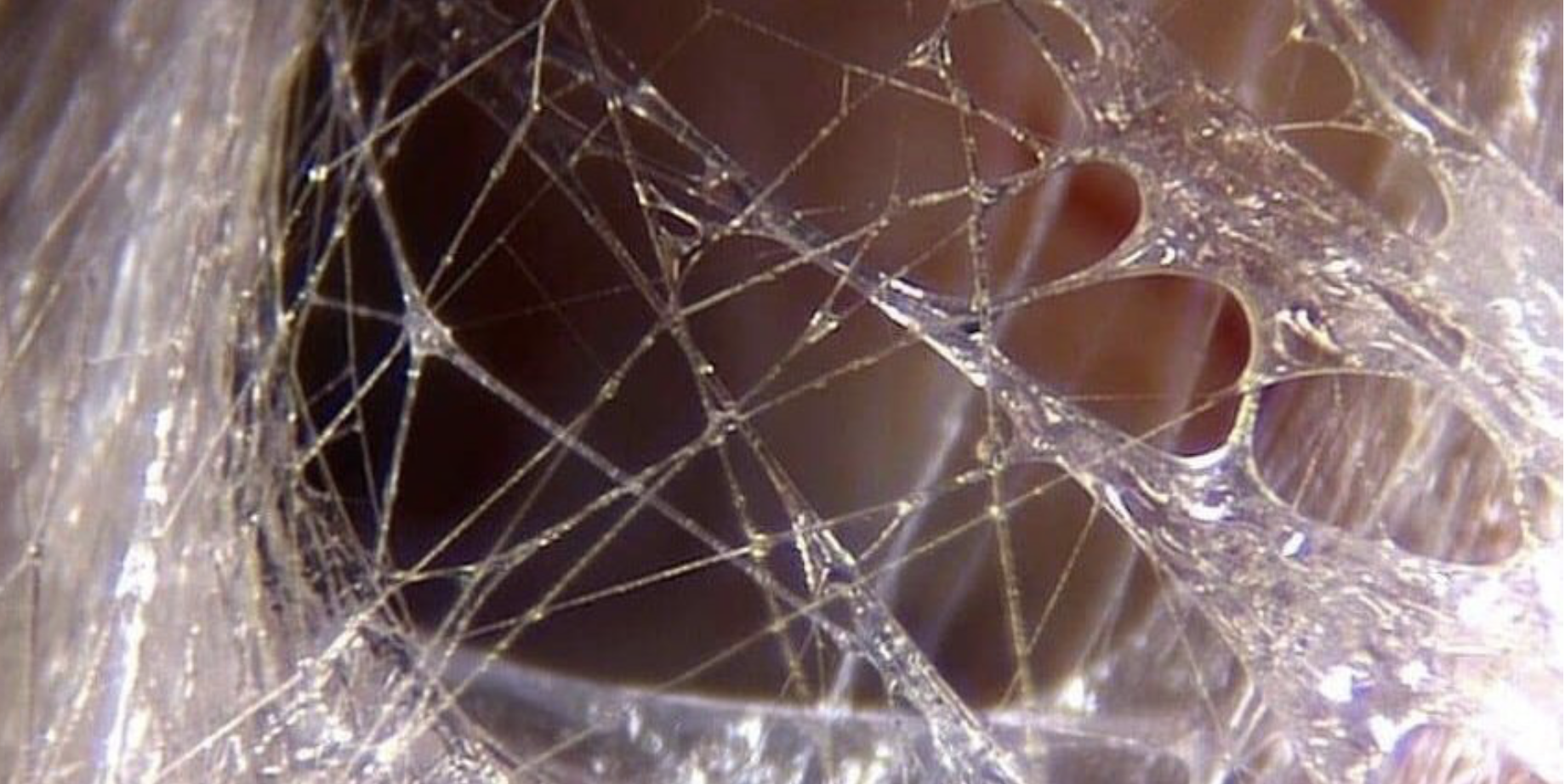
Fascia under a microscope
Why This Work Is Different
Most of us grow up thinking of pain as a muscle problem — something tight that needs to be loosened, something we tweaked that needs time to heal. And while that's not entirely wrong, it's a little like describing a traffic jam by pointing at one car. The body doesn't work in isolated parts, and pain rarely originates where it announces itself. Beneath the muscles and bones lies a continuous web of connective tissue called fascia, and woven through it, a fluid-filled network researchers now call the interstitium. Together these systems transmit force, carry information, and quietly hold the accumulated story of everything your body has been asked to do; every repetitive motion, every old injury, every season of sustained stress written in our fascia. What makes this particularly stubborn is that the body is always trying to help: when it senses repeated stress or strain in an area, it responds by laying down new collagen fibers along those lines of force, essentially reinforcing the pattern it thinks you need. Over time, what began as adaptation becomes architecture. When that system becomes restricted, the effects ripple far beyond any single location. You feel it, even if you can't quite name it.
Working With the Body, Not On It
Here's what I've learned in nearly thirty years of this work: the body doesn't give up its patterns without a reason to. It has held onto them for good cause — compensating, protecting, adapting, and it needs to feel genuinely met before it will consider doing anything differently. This is the part that's hardest to explain and most important to understand. Most bodywork is done on the body — targeting a symptom, addressing a structure, working toward a predetermined outcome. What happens here is different; working with the body, listening as much as doing, following the body's lead rather than imposing a direction, creating space for the system to reorganize around something better than what it's been holding. Communicating directly with the nervous system to release patterns the body has been holding for years. What changes in a session isn't just the tissue itself but the body's relationship to the pattern it's been living in; creating a space where the structure and nervous system work in harmony, not in constant fight or flight mode. That shift happens at a depth that most people haven't experienced before, re-establishing the body’s innate relationship with gravity, resulting in sustained, long-term results.
The tools I use — Structural Integration, Myofascial Release, CranioSacral Therapy, Zero Balancing, and where appropriate, cupping, laser, vibration and light therapy — are each chosen because they speak to this same underlying system through different and complementary means. Some decompress and open tissue mechanically in ways that hands simply can't replicate. Others work at the level of the nervous system, or at the deeper energetic currents that ZB teaches us run through bone. Used together thoughtfully, they create conditions the body rarely experiences: enough space, enough time, and enough support to actually reorganize rather than simply relax. The goal has never been just relief. It has always been restoration — a body that moves differently, holds itself differently, and stops generating the same patterns that brought you here in the first place. You already know what that feels like. Let's find our way back to it.